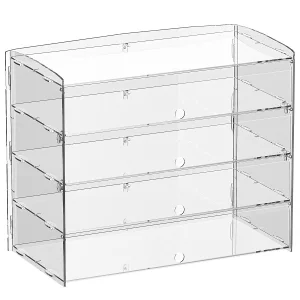
Factory-direct industrial-grade drawer units, counter organizers, and multi-tier displays manufactured under strict ISO 9001 quality controls.
Global supply chain leaders prioritize dimensional stability, optical transmission rates exceeding 92%, and chemical resistance when sourcing acrylic drawer organizers.
Tier-1 cosmetic retail conglomerates require modular drawer inserts manufactured from virgin methyl methacrylate (MMA). These organizers demand high solvent resistance against volatile fragrance oils and alcohol-based cosmetic foundations, combined with glass-like diamond-polished chamfering.
Healthcare facilities and cleanroom laboratories require specialized static-dissipative acrylic polymers with tight engineering tolerances (±0.1mm) to prevent contamination, ensure non-reactive reagent storage, and support robotic sample handling.
Direct-to-consumer lifestyle brands require ISTA-3A compliant drop-tested acrylic drawer architectures. Designs feature integrated interlocking ribs, reinforced corner gussets, and high-tensile packaging configurations that reduce transit damage below 0.3%.
Integrating high-tonnage injection molding with precise fabrication to scale complex custom acrylic designs.
Our facilities utilize continuous casting machines and multi-cavity injection molds. Using ultra-pure Lucite and Mitsubishi chemical precursors, our drawer organizers maintain high transparency with minimal internal birefringence stress.
Complex multi-compartment organizers demand precise perimeter cuts and polished edge profiles. Our five-axis CNC routers handle continuous dovetail slide tracks, internal divider slots, and finger-pull chamfers with minimal thermal degradation.
For bespoke retail display boxes, our fabrication technicians employ solvent capillary welding and UV photo-initiator curing. This process yields optically clear seams with shear strength ratings exceeding 42 MPa.
| Technical Characteristic | Cast Acrylic (PMMA) | Extruded Acrylic (PMMA) | Injection Molded Polystyrene (PS) |
|---|---|---|---|
| Refractive Index / Clarity | 1.49 (Crystal Transparency >92%) | 1.49 (High Transparency ~92%) | 1.59 (Good ~88-90%, Hazing over time) |
| Impact Resistance (Izod) | 16–20 kJ/m² (High) | 14–17 kJ/m² (Medium) | 2–4 kJ/m² (Brittle) |
| Chemical Resistance | Superior resistance to alcohol & lipids | Moderate; susceptible to stress crazing | Poor; vulnerable to solvent dissolution |
| Dimensional Precision | ±0.10 mm (Subtractive Machining) | ±0.05 mm (Laser/Routing) | ±0.02 mm (Cavity Shrinkage Dependent) |
| Ideal Procurement Application | Bespoke luxury counters, thick-wall furniture | High-density drawer dividers, modular trays | Budget, high-volume disposable organizers |
Pioneering next-generation polymer technologies to balance optical clarity with environmental and IoT requirements.
To satisfy ESG procurement mandates across European and North American markets, our engineering team has integrated depolymerized post-consumer PMMA (R-MMA). This process reduces lifecycle carbon emissions by 40% while preserving high optical transmission and thermal stability.
Standard acrylic has a surface pencil hardness rating of 2H to 3H. We offer vacuum-deposited siloxane-based nanocomposite hard-coatings that elevate surface durability to 6H. This provides resistance against scratch micro-abrasions, detergent degradation, and static dust build-up.
We are currently developing smart drawer organizers engineered with RF-transparent sensor cavities. These slots support passive UHF RFID asset tracking tags and optical weight arrays, enabling automated inventory re-ordering for specialized medical dispensaries and luxury boutique networks.
Comprehensive material verification, food-contact testing, and safety certifications for global markets.
Organizers destined for kitchen environments, pantry systems, and cosmetic storage undergo migration tests for overall extractables (OML) and specific monomer migration limits under FDA 21 CFR 177.1010 and EU Commission Regulation (EU) No 10/2011.
Every production lot is screened for SVHC (Substances of Very High Concern) under EU REACH Annex XVII. We confirm the complete absence of phthalates, halogenated flame retardants, bisphenol A (BPA), and regulated heavy metals across our transparent acrylic resin supplies.
Our engineering team designs custom packaging for international container freight and e-commerce handling. Designs undergo ISTA 3A testing, including 10-point drop profiles, random vibration testing, and compressive load evaluations.
Detailed answers regarding tooling costs, fabrication lead times, material specs, and supply chain management.
Explore our custom OEM product line, supporting corporate gifts, luxury retail fixtures, and modular cases.