Engineered for high-traffic commercial environments, optical excellence, and high aesthetic clarity.
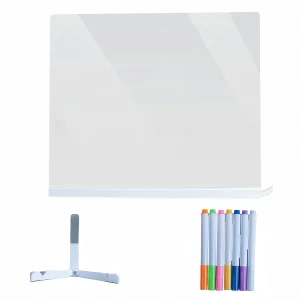

Strategic analysis of why enterprise purchasers are migrating away from traditional glass and styrene.
Poly(methyl methacrylate), commonly termed cast acrylic, provides a luminous transmission rate of 92.5% to 93%, exceeding standard soda-lime float glass (typically 88%–90%). In architectural signage, the absence of the greenish tint characteristic of unpurified glass provides complete chromatic fidelity for corporate branding colors. Furthermore, cast PMMA features zero birefringence when annealed, eliminating visual distortion across wide viewing angles in corporate lobbies and gallery spaces.
Global commercial regulatory frameworks (such as OSHA in North America and EN 12600 in the EU) mandate rigorous shatter-resistance parameters for retail fixture installations. Clear acrylic signs offer up to 17 times the impact resistance of annealed glass at half the volumetric weight (1.19 g/cm³ versus 2.5 g/cm³). When subjected to catastrophic loading, PMMA yields dull-edged fractures rather than high-velocity shards, significantly lowering public liability insurance exposure for international retail chains.
The sign and display industry has evolved past static signage into integrated digital touchpoints. Utilizing laser micro-dotting and CNC V-grooving, clear PMMA panels serve as ultra-thin Light Guide Plates (LGP), distributing edge-lit LED lumens uniformly across the entire display face with zero hot spots. Modern installations natively accommodate near-field communication (NFC) badges and embedded capacitive sensors without degrading RF transmission profiles.
How concentrated petrochemical clusters, vertical integration, and rapid prototyping define the modern procurement value equation.
Operating within the Yangtze River Delta industrial belt (specifically Danyang, Jiangsu), our infrastructure leverages proximate upstream Methyl Methacrylate (MMA) synthesis facilities. Access to 99.9% pure virgin MMA monomer eliminates optical yellowing risks caused by recycled regrind blends. Local downstream supply ecosystems for UV-curable inks, anodized aluminum standoffs, and optical-grade masking film eliminate intermediate logistics markups and buffer against raw material lead-time fluctuations.
Achieving cost advantages on volume orders relies on precision manufacturing. Utilizing multi-station continuous-path CNC routers running diamond-tipped bits alongside high-wattage sealed CO₂ laser cutters, our factory delivers automated nest-cutting routines that increase raw acrylic sheet utilization to over 91%. Edge geometry finishing—spanning chemical flame polishing, high-speed buffing, and single-crystal diamond polishing—proceeds continuously in-line without transit degradation.
Cleanroom-based Class 10,000 printing bays prevent particulate contamination during CMYK+White UV flatbed printing runs. Surface tension parameters are tested using dyne pens prior to ink application to guarantee cross-hatch adhesion scores of 5B (ASTM D3359). Every batch undergoes thermal cycle testing (-15°C to 65°C) to simulate container maritime transit, verifying that stress-crazing does not occur around laser-cut standoff holes or along solvent-bonded seams.
Engineered acrylic sign applications across luxury retail, commercial architecture, high-volume hospitality, and corporate workspaces.
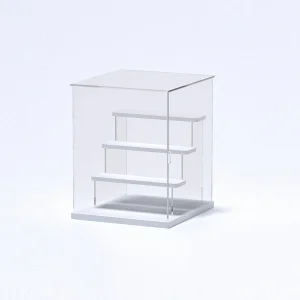
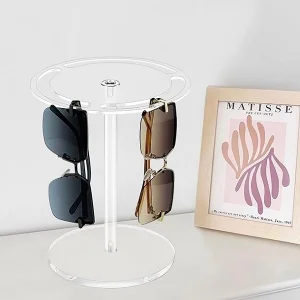
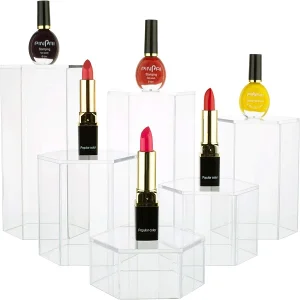
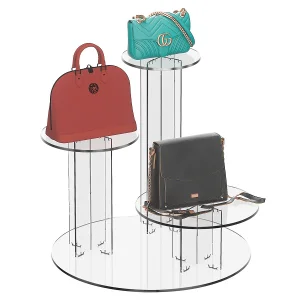
Cosmetic department store counters and consumer electronics flagships require clear, optically pure display stands that emphasize merchandise without visual clutter. Custom clear acrylic signage integrates sub-surface reverse-printed graphics, high-polish bevels, and integrated anti-theft sensor slots. Acrylic signs resist the micro-scratches caused by daily cleaning regimens when treated with functional anti-static, polysiloxane hard-coat finishes.
Modern commercial campuses utilize modular clear acrylic signage suspended with brushed 304/316 stainless-steel standoffs. These panels combine clear polished faces with satin frosted backings to allow high visual contrast in multi-floor tenant directories. Standoff mounting systems permit rapid document changes via magnetic or micro-suction retention layers, eliminating the need to dismount hardware during tenant updates.
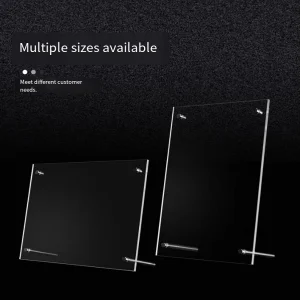
Hotel corridors, convention centers, and multi-location QSR brands require high numbers of double-sided, heat-bent T-style or slanted L-style menu stands. Production lines utilize cast PMMA that withstands frequent alcohol-based sanitization without developing micro-fissures or stress fogging. Stacking-rib packaging prevents friction abrasion during volume sea container delivery.
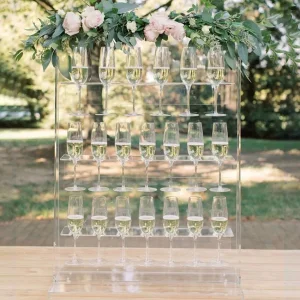
Luxury weddings, product unveilings, and galas demand expansive visual impact. Freestanding structural champagne walls, illuminated welcome placards, and large-format notice boards require high structural rigidity. By engineering interlocking base joints and utilizing panels up to 25mm thick, our fabrication teams build freestanding display structures that support substantial weight while maintaining optical clarity.
A systematic technical evaluation framework for enterprise buyers, procurement executives, and visual display specifiers.
| Performance Metric | Virgin Cast PMMA (Xinquan Primary) | Extruded PMMA (Economical) | Polycarbonate (PC) | Polystyrene (PS / Cheap Imitation) |
|---|---|---|---|---|
| Light Transmission (%) | 92.8% (Maximum optical clarity) | 91.5%–92.0% | 88.0%–89.0% | 87.0% (Prone to early haze) |
| Laser Engraving Quality | High-contrast frosted finish | Clear, melted rim, low contrast | Discolors (Brown/charred edges) | Melted edges, hazardous flammability |
| Surface Hardness (Rockwell M) | M-95 to M-100 (Scratch resistant) | M-90 | M-70 (Very soft, scratches easily) | M-65 to M-70 (Extremely fragile) |
| UV Degradation (10-Yr Outdoors) | <1.5 Delta E (No yellowing) | Moderate yellowing without additives | Severe yellowing unless UV-coated | Rapid breakdown and brittleness |
| Edge Finishing Properties | Diamond, flame, and chemical polish | Diamond polish (Thermal sensitive) | Cannot be flame or diamond polished | Poor edge, tends to chip cleanly |
| Total Cost of Ownership | Lowest long-term cost for premium signs | Economical for mass rollouts | High raw material cost overhead | Lowest upfront, frequent replacement |
Engineered to custom technical drawings with factory-direct pricing and verified logistics handling.


Detailed engineering, manufacturing, and logistic inquiries answered by our production technical director.
Our pricing advantage stems from complete vertical integration within our 30,000 square meter factory in Danyang, Jiangsu. By ordering virgin MMA bulk monomers directly from petrochemical producers and performing casting, laser cutting, diamond polishing, screen/UV printing, and thermoforming in-house, we remove intermediate trading margins. Continuous automated nesting software achieves over 91% sheet utilization, significantly reducing raw material scrap costs on volume orders.
Yes. Our pre-production engineering department works with standard file types, including DXF, DWG, STEP, IGES, AI, and vector PDF. Before initiating mass fabrication, every drawing undergoes a Design for Manufacturability (DFM) review. This process checks stress concentrations, hole distances relative to sheet edges, and tolerance compatibility (typically ±0.1 mm via laser or CNC cutting). We provide physical pre-production samples for client verification before cutting production panels.
Crazing (fine internal network cracking) occurs when internal stresses interact with aggressive chemical solvents or thermal shocks. We mitigate this by using virgin casting resins with low internal stress and annealing fabricated items when tight radii are thermoformed. To prevent photolytic discoloration, our resins incorporate chemical UV absorbers (such as benzotriazole stabilizers) that prevent degradation and yellowing for more than ten years of continuous indoor display.
Surface preservation is critical for clear PMMA shipments. Every panel retains a dual-sided, co-extruded polyethylene (PE) protective film or heavy saturated craft masking paper throughout manufacturing, cutting, and drilling. Products are individually partitioned using micro-foam sheeting and multi-wall honeycomb corrugated dividers. For LCL consolidation or oversized structural items (such as champagne walls), we use ISPM-15 compliant, heat-treated fumigated plywood crates equipped with shock-absorbing corner buffers.
Flame polishing uses a high-temperature oxyhydrogen flame to melt surface irregularities, producing a glossy edge suitable for simple geometry. However, it introduces thermal stress along the edges, making the material vulnerable to solvent-induced crazing if cleaned with alcohol. Diamond edge polishing feeds panels through high-speed, PCD-tipped diamond fly-cutters. This mechanical process produces a flat edge with glass-like optical clarity, maintains squareness without rounding, and leaves no residual thermal stress in the panel.
Because we operate automated laser setups alongside batch-processing assembly lines, our standard minimum order quantity starts as low as 50 to 100 units for custom-fabricated signage profiles, with flexibility for custom enterprise store rollout prototypes. Rapid tooling and digital laser setups allow physical samples to be produced and dispatched within 5 to 7 business days. Full 20ft/40HQ shipping container orders are manufactured within 15 to 25 business days, supported by direct port routing through Shanghai and Ningbo maritime hubs.
