Explore eight core industrial display cases, retail vitrines, and custom geometric stands engineered with diamond-milled edges and museum-grade optical purity.
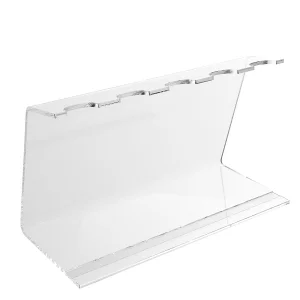
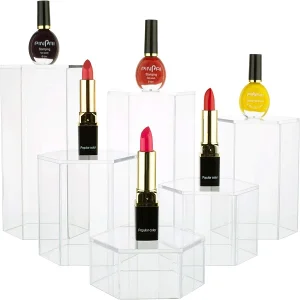

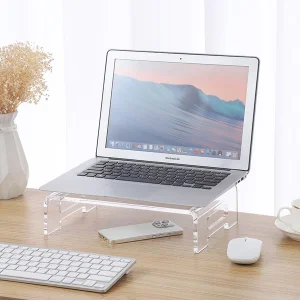




A technical analysis of polymethyl methacrylate (PMMA) fabrication, optical physics, total cost of ownership (TCO), and automated supply chain architectures.
Unlike standard float glass which exhibits a green iron-oxide cast, virgin-grade cell cast PMMA offers an exceptional ~92% luminous transmittance across the visible spectrum (380–780 nm). For luxury retail vitrines, medical device enclosures, and delicate collector display cases, cast acrylic eliminates color chromatic aberration while blocking destructive UV wavelengths (up to 99% with UV-absorbing additives).
PMMA possesses a density of 1.19 g/cm³—roughly half that of soda-lime glass—while boasting up to 17 times higher impact resistance. For architectural installations, retail chains, and international maritime logistics, this weight reduction lowers freight expenditures by up to 42% and drastically minimizes catastrophic transit breakage rates during rough sea and air movements.
Traditional adhesives cause unsightly cloudiness, micro-bubbles, and solvent crazing. Our facility employs pure monomer solvent polymerization and UV-curable adhesives under filtered positive-pressure clean rooms, causing the acrylic sheets to fuse at the molecular polymer chain level, producing crystal-clear, water-tight seams capable of sustaining immense hydrostatic and mechanical stresses.
Design for Manufacturability (DFM) Notice: High-volume global retail programs require precise thermal expansion accommodation (PMMA thermal expansion coefficient: 0.07 mm/m/°C). Our in-house engineering team conducts stress-simulation modeling on CAD files before tooling cuts commence, ensuring that large-format custom acrylic cases fit mating metal, wood, or glass sub-assemblies flawlessly across wide temperature ranges.
Targeted manufacturing methodologies matched to exacting technical requirements—from cleanroom semiconductor equipment to luxury retail rollouts.
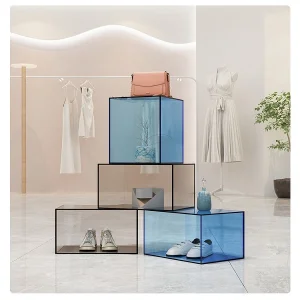
High-end boutiques require non-glare, anti-reflective, and ultra-high clarity acrylic vitrines that heighten perceived product value. We fabricate high-security locked cases with concealed museum hinges, dust-proof labyrinth perimeter gaskets, and integrated high-CRI (>95) LED lighting channels engineered into 25–40mm thick cast bases.
For cleanroom environments, semiconductor assembly lines, and automated robotic enclosures, electrostatic discharge (ESD) presents catastrophic contamination risks. We engineer static-dissipative clear acrylic cases with surface resistivity between 10⁶ to 10⁸ Ω/sq, preventing particulate attraction and sensitive IC breakdown.
Artifact preservation demands chemically inert display vitrines that emit no volatile organic compounds (VOCs) or acidic off-gassing that could degrade ancient parchment, textiles, or metals. Our vacuum-annealed museum cases comply with stringent Oddy testing standards for long-term unreactive encapsulation.
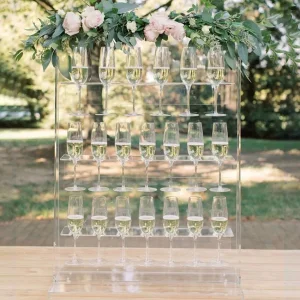
From freestanding acrylic champagne walls with custom-routed stemware slots to architectural reception lecterns and tiered banquet pedestals, we engineer structural acrylic systems that combine aesthetic grandeur with rapid flat-pack assembly for rental fleet managers and event production groups.
The global collector market demands ultra-clear acrylic display cases for high-value designer toys, graded comic books, trading cards, and brick model assemblies. We supply high-volume retail packaged acrylic cases with magnetic sliding lids, stackable nesting ridges, and custom mirror backplates.
Acrylic's exceptional structural bonding strength makes it indispensable for luxury aquatic exhibits, hotel lobby water walls, and heavy thick-slab swimming pool viewports. We process cast slabs from 20mm up to 100mm+ thickness with deep annealing ovens to eliminate visual distortion under hydraulic loads.
A procurement comparison table identifying fundamental differences in optical transmission, machining behavior, thermal characteristics, and cost structures.
| Performance Parameter | Cell Cast PMMA (GS Grade) | Continuous Extruded PMMA (XT Grade) | Engineered Polycarbonate (PC) Alternative |
|---|---|---|---|
| Manufacturing Process | Batch cast between precision float glass sheets | Continuous screw extrusion through calendar dies | High-pressure polymer extrusion |
| Optical Light Transmission | 92.5% to 93% (Highest possible clarity) | 91.5% to 92% (Excellent transparency) | 88% to 89% (Slight dark cast) |
| Laser Engraving Outcome | Frosted brilliant crisp white (High contrast) | Clear molten melt-in (Lower contrast) | Brown/burn discoloration (Unsuitable) |
| Solvent Chemical Resistance | High resistance to crazing, stress cracking | Moderate; sensitive to alcohol / hydrocarbon cleaners | Low to moderate without specialized hardcoat |
| Thickness Tolerance | ±(0.4 + 0.1 × thickness) mm (Standard cast curve) | ±0.05 mm to ±0.1 mm (Extremely uniform) | ±0.1 mm to ±0.2 mm |
| Edge Finishing Performance | Diamond & flame polished to pristine jewel clarity | High-speed diamond polished; flame requires care | Requires vapor polishing or mechanical buffing |
| Maximum Available Thickness | Up to 150 mm+ for architectural slabs | Typically limited to 1 mm – 15 mm | Commonly 0.5 mm – 15 mm |
| Best-Fit Application Areas | Luxury display vitrines, aquariums, high-end signage | High-run menu stands, brochure boxes, thin dustcovers | Bulletproof blast shields, vandal-prone covers |
Cell cast acrylic possesses a significantly higher molecular weight compared to extruded PMMA. During high-speed CNC milling and 500W CO₂ laser cutting, cast acrylic does not melt or produce gummy slag along the kerf. More importantly, when building multi-axis cases that require solvent welding, cast acrylic resists internal stress crazing, yielding razor-sharp, bubble-free miters that remain structurally sound for decades.
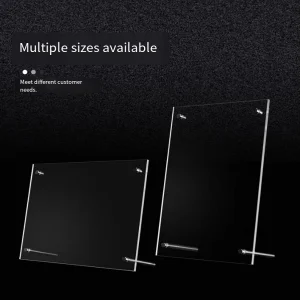
Extruded acrylic sheet features exceptional gauge consistency from edge to edge. When fabricating high-volume flat-pack sign frames, slot-together menu displays, and slide-in photo boxes where tight groove tolerances are mandatory, extruded PMMA prevents loose fits or jamming caused by casting gauge variations, providing up to 20% direct raw material savings on large container orders.
From digital DFM drawing ingestion to final container dispatch, all manufacturing processes remain strictly consolidated within our 30,000m² manufacturing facility in Danyang.
Every incoming CAD (.DWG, .DXF), STEP, or Adobe Illustrator vector file undergoes thorough Design for Manufacturability review. Our senior tooling engineers analyze thermal expansion gaps, cantilever stress tolerances, wall thickness requirements, and shipping carton pack-out densities.
Virgin MMA-derived PMMA sheets are conditioned in humidity-controlled staging areas to stabilize internal sheet moisture. Protective polyethylene (PE) or heavy craft paper masking remains intact to prevent micro-marring throughout CNC handling and initial layout slicing.
Multi-spindle automatic tool-changer CNC routing centers and high-wattage sealed CO₂ laser cutters execute profiles holding strict ±0.1mm tolerances. Laser cutting leaves a flame-smooth cut, while CNC routing facilitates complex countersinks, o-ring grooves, and stepped rebated joints.
Cut parts are processed through automated single-crystal diamond polishing machines. Synthetic monocrystalline diamond tooling spins at 12,000 RPM, removing microscopic cutting marks and imparting an optically transparent, mirror-finish edge ready for solvent joining or exposed display borders.
Multi-zone line heaters and precision drape molds facilitate smooth, stress-relieved radii bends without surface blistering or whitening. For case assembly, specialized capillary solvent adhesives or photo-polymerizing UV adhesives cure under 365nm UV irradiation, forming seamless 90° corners.
Multi-channel flatbed UV printers apply high-opacity white ink barriers and photo-realistic corporate logos up to 2400 DPI with scratch-resistant primers. Every finished unit undergoes metrological inspection using digital calipers, optical polariscopes, and 100% surface scratch auditing.
Protecting your brand and physical goods with international material compliance certifications and engineered damage-proof crating architectures.
All virgin PMMA resins and UV inks processed by Danyang Xinquan are certified non-toxic and compliant with European REACH (Regulation EC 1907/2006) for Substances of Very High Concern (SVHC) and RoHS Directive 2011/65/EU. Food presentation cases and dinnerware stands comply with FDA 21 CFR 177.1010 for direct food contact safety.
Acrylic display cases fail during transit when packaged incorrectly. Every custom production run undergoes ISTA 3A physical drop simulation testing. We utilize high-density closed-cell EPE (Expanded Polyethylene) foam cut out by automated CNC blades to cradle every case edge, encased in double-wall 275 lb burst-strength corrugated export master cartons.
For oversized items like custom acrylic champagne walls, museum vitrines, and monolithic retail showcases, shipments are fortified within custom IPPC-certified ISPM-15 heat-treated plywood crates with built-in tilt sensors and shock indicators, facilitating damage-free ocean FCL, LCL, and air cargo delivery to over 50 destination nations.
Anticipating the technological frontier: circular recycled rMMA resins, smart IoT touch vitrines, and nanotech hard-coatings.
Responding to global corporate ESG mandates, our material roadmap incorporates depolymerized recycled methyl methacrylate (rMMA). Chemical recycling returns post-industrial and end-of-life acrylic to virgin monomer purity, achieving identical 92% light transmission while reducing manufacturing carbon footprints by 70%.
To overcome acrylic's intrinsic surface softness, our finishing labs are deploying flow-coated polysiloxane nanocoatings. This creates an optical glass-like hard-coat on exterior case surfaces that elevates pencil hardness from standard 2H up to 6H–7H, delivering extreme chemical resistance against aggressive sanitizers.
The convergence of retail cases with smart electronics is accelerating. We engineer precision-cavity acrylic enclosures featuring integrated capacitive touch sensors, edge-lit wave-guided laser dot patterns, and flush rebates engineered specifically to house transparent OLED display panels inside vitrine doors.
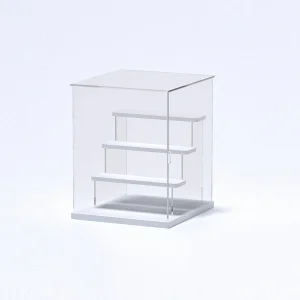
Explore eight specialized acrylic product lines manufactured to your exact CAD drawings, custom colors, and custom-branded retail requirements.



Direct technical answers to questions commonly posed by overseas purchasing managers, supply chain controllers, and commercial fit-out contractors.
