Global beauty purchasing is expanding, and storage is becoming part of the buying decision. Grand View Research estimates that the global cosmetics market reached USD 343.37 billion in 2023. It also forecasts continued growth through 2030. More products mean more brushes, palettes, bottles, and daily organization challenges.
Clear Acrylic Makeup Storage can make those items visible at a glance. That matters in small bathrooms, retail displays, and professional makeup stations. Marie Kondo, a recognized organizing expert, said, “The objective of cleaning is not just to clean, but to feel happiness living within that environment.” Her principle fits transparent storage, although appearance alone cannot guarantee better organization.
Global buyers must examine more than crystal-clear panels. Check acrylic thickness, edge finishing, drawer alignment, load capacity, and packaging protection. A heavy palette should not bend a thin shelf. Humid climates also demand careful material selection and easy-to-clean surfaces. Grand View Research identifies rising online beauty sales as a major market influence, making product dimensions and shipping durability increasingly important.
Small details matter. A 2-centimeter height difference can block a lipstick row. Buyers should compare internal measurements, not only exterior photos. Sustainability also deserves attention, because acrylic is durable but still plastic. Reusable designs may offer better value than disposable organizers. This guide provides seven practical tips for sourcing, evaluating, and using Clear Acrylic Makeup Storage across different markets. Some recommendations may need adjustment. Local habits, climate, and product sizes are never identical.
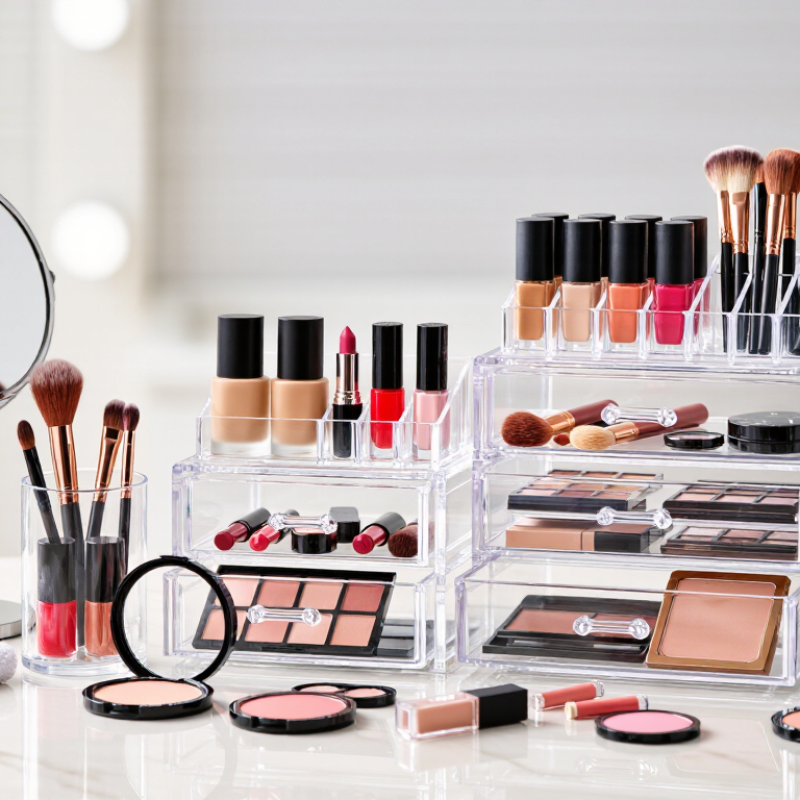
Acrylic storage looks simple, but material grade affects daily safety and service life. For makeup organizers, buyers commonly compare cast acrylic with extruded acrylic. Cast acrylic usually offers clearer surfaces, better thickness consistency, and cleaner polished edges. Extruded acrylic can reduce cost, but it may show more stress marks during cutting. Ask suppliers to state the PMMA type, thickness, color clarity, and tolerance. Do not accept “premium acrylic” without technical details.
A clear panel is not automatically a safe panel. Request test reports for impact resistance, haze, light transmission, and chemical compatibility with common makeup residues. ISO or ASTM methods may support these claims, but the test version and sample thickness matter. Confirm whether reports cover the exact production material. Safety documentation should also address restricted substances under the destination market’s rules. Requirements differ across regions. Check local compliance before importing large volumes.
Inspect samples under bright light. Look for sharp corners, cloudy patches, bubbles, strong odors, and unstable bases. A smooth surface helps cleaning, but acrylic can scratch from rough cloths or abrasive powders. Use mild soap and a soft microfiber cloth. Keep organizers away from radiators and intense sunlight, because acrylic can soften, discolor, or become brittle. I have seen attractive samples fail after careless packaging. That lesson is easy to overlook. Require protective film, corner guards, drop-test evidence, and batch traceability. “Shatterproof” may also be too broad; ask for measured performance instead.
Identify acrylic grades and safety requirements before purchasing makeup organizers. The chart shows representative visible-light transmittance values for common clear PMMA grades; actual performance varies by formulation, thickness, and supplier.
Reference points: Clear PMMA commonly has approximately 90–92% visible-light transmittance, a density near 1.18 g/cm³, and a Vicat softening temperature around 100–115°C, depending on grade and test method. Optical transmittance may be evaluated using ISO 13468-1, while softening behavior may be evaluated using ISO 306. These values are material references, not guarantees for a specific product.
Choosing the right acrylic makeup storage starts with the collection, not the cabinet. Measure the tallest bottle, widest compact, and deepest palette before ordering. Leave about two centimeters of spare height for easy removal. Measure twice. Guessing often creates awkward gaps.
Small collections benefit from narrow drawers, shallow trays, and two-tier risers. These layouts keep daily products visible without using much counter space. A larger collection needs zones for skincare, complexion products, eye makeup, and brushes. Deep compartments suit backup items, but shallow sections work better for frequently used cosmetics. Round containers may waste square corners. Adjustable dividers can reduce that problem.
From practical storage planning, clear acrylic is useful because users can identify products without opening every drawer. Check panel thickness, smooth edges, drawer movement, and weight limits before purchasing. International buyers should also compare internal dimensions, not only external measurements. Packaging quality matters during long-distance transport. A cracked corner can make an otherwise attractive organizer unusable. Keep it visible. However, complete transparency is not always ideal; dust and visual clutter appear quickly. A covered section may suit rarely used products better. I once prioritized maximum capacity and regretted the crowded layout, so leave room for future additions instead of filling every compartment.
Clear acrylic storage looks simple, but each design solves a different problem. Stackable drawers protect palettes and keep dust away. Tiered trays improve visibility for small items. Rotating organizers save counter space, although they may wobble on uneven surfaces. Buyers should compare wall thickness, drawer smoothness, ventilation, and weight limits. Thin panels often look attractive but can crack during international shipping.
The global beauty market is projected to approach $580 billion by 2027, according to McKinsey’s 2023 beauty industry report. That growth increases demand for flexible, easy-to-ship storage. However, appearance should not dominate the decision.
The World Health Organization reported in 2022 that about 1.3 billion people experience significant disability. Accessible storage needs low opening force, clear labels, rounded edges, and handles that are easy to grip. Small details matter.
Transparent acrylic helps users locate products quickly, but glare can reduce readability. I prefer lightly frosted labels in bright rooms. That choice is not perfect. Frosting may hide small items from a distance. Buyers should also verify recyclable packaging, replacement-part availability, and cleaning instructions before ordering. A beautiful organizer is less useful when one broken drawer ends the whole system.
Clear Acrylic Makeup Storage Tips for Global Buyers
Clear acrylic organizers look simple, but supplier selection requires careful checking. Request a recent factory video, material specification, and inspection records. Ask whether the acrylic is virgin PMMA, not mixed recycled material. A 3 mm panel should feel rigid, with polished edges and no cloudy stress marks. I have learned that one approved sample proves little. Request samples from different production batches.
Customization affects both appearance and shipping cost. Confirm exact dimensions, drawer tolerances, logo methods, color transparency, and protective film requirements. According to Smithers’ packaging industry analysis, premium packaging increasingly depends on appearance, protection, and efficient material use. Therefore, test a fully packed unit, not an empty one. A small dimensional change can increase carton volume sharply. That detail is easy to miss.
Shipping terms need equal attention. Use ICC Incoterms 2020 and write the named place clearly, such as FOB Ningbo or DDP Toronto. Confirm who pays freight, insurance, duties, destination handling, and possible storage fees. The UNCTAD Review of Maritime Transport 2024 highlights continuing volatility in global shipping routes and costs. Ask for two freight quotations and a validity period. Do not rely on vague “door-to-door” promises. My own preference is a written cost sheet, although it can still contain errors. Check it against the commercial invoice, carton count, and packaging photos before payment.
Clear acrylic organizers look clean only when their surfaces and storage habits receive regular care. Weekly dusting with a soft microfiber cloth prevents powder particles from creating fine scratches. Use lukewarm water and a small amount of mild soap for fingerprints or foundation residue. Rinse the cloth carefully, because trapped grit can mark acrylic.
Dry every compartment completely before returning cosmetics. Moisture left beneath bottles can encourage bacteria and cloudy stains. Keep creams, brushes, and sponges in separate sections. Brushes should be dry before storage. Damp tools are a hygiene problem. Avoid ammonia, abrasive powders, rough paper towels, and strong solvents, which may cause crazing or permanent dullness. Direct sunlight and high heat can also weaken clarity over time.
Inspect hinges, corners, and drawer edges each month for cracks or loose parts. Replace damaged organizers before sharp edges affect hands or products. Wipe product containers before placing them inside, especially after spills. Keep the organizer away from sinks and steamy windows when possible. I once cleaned acrylic with a powerful household spray, believing stronger meant better. It left a faint haze that never disappeared. That mistake changed my routine: gentle cleaning, full drying, and patient handling now protect both appearance and hygiene. For global buyers, care instructions should be tested on a hidden area first, since acrylic formulas and finishes can vary.
| No. | Maintenance Dimension | Recommended Practice | Suggested Frequency | Reason | Avoid |
|---|---|---|---|---|---|
| 1 | Routine Dust Removal | Use a clean, soft microfiber cloth or a hand-operated air blower. Wipe in one direction rather than rubbing dust particles across the surface. | Daily or every 2–3 days | Removes abrasive particles, powder residue, and loose debris before they accumulate in corners or scratches. | Paper towels, rough fabrics, brushes with hard bristles, and compressed air held too close. |
| 2 | Safe Surface Cleaning | Mix lukewarm water with a small amount of mild, non-abrasive dish detergent. Apply the solution to the cloth, not directly to the organizer, then wipe gently. | Weekly or when visibly soiled | Mild detergent helps lift cosmetic oils and fingerprints without relying on harsh solvents. | Ammonia-based cleaners, abrasive powders, strong solvents, and scouring pads. |
| 3 | Complete Drying | Dry all panels, joints, drawers, and textured areas with a fresh microfiber cloth. Leave the organizer open until no visible moisture remains. | After every wet cleaning | Reduces water spots and limits moisture buildup around cosmetics, seams, and enclosed compartments. | Storing products while the organizer is still damp or soaking acrylic components in water. |
| 4 | Cosmetic Residue Control | Clean foundation, lipstick, cream, and oil residue as soon as possible. Use cotton swabs or a soft cloth for narrow corners and drawer tracks. | Immediately, or within 24 hours | Fresh residue is easier to remove and is less likely to harden, stain, or transfer between stored items. | Scraping dried makeup with metal tools or using excessive force on drawers and dividers. |
| 5 | Hygienic Product Storage | Keep containers closed, place clean products inside, and separate used applicators from unused makeup. Do not overfill compartments. | Check daily; reorganize weekly | Closed packaging and adequate spacing help reduce spills, dust exposure, and cross-contamination. | Leaving open creams or brushes in dusty areas and placing wet tools directly into compartments. |
| 6 | Light and Temperature Management | Keep the organizer away from direct sunlight, radiators, heaters, and high-heat appliances. Use a shaded, room-temperature location whenever possible. | Continuous practice | Long-term ultraviolet exposure and heat can contribute to discoloration, distortion, or accelerated aging of some acrylic products and cosmetics. | Windowsills with strong sun, hot bathrooms, enclosed spaces beside heat sources, and rapid temperature changes. |
| 7 | Inspection and Replacement | Inspect for cracks, sharp edges, loose dividers, cloudy areas, or damaged drawers. Stop using any part that may cut skin or contaminate products. | Monthly and after shipping | Early inspection supports safe use and helps buyers identify transport damage before the organizer is fully stocked. | Continuing to use cracked panels, forcing misaligned drawers, or repairing structural damage with unsuitable adhesives. |
Cast acrylic usually offers clearer panels, steadier thickness, and cleaner polished edges. Extruded acrylic may cost less. It can show more cutting stress. The cheaper option is not always wiser.
Ask for the PMMA type, panel thickness, color clarity, and production tolerance. Do not accept vague terms like “premium acrylic.” Request written specifications.
Request reports covering impact resistance, haze, light transmission, and chemical compatibility. Confirm the report matches the exact material and sample thickness. Check local compliance rules before importing large quantities.
Examine it under bright light. Look for sharp corners, cloudy patches, bubbles, strong odors, and an unstable base. Test drawer movement and edge smoothness. Small defects matter.
Use mild soap and a soft microfiber cloth. Rough fabrics and abrasive powders can scratch the surface. Keep the organizer away from radiators and intense sunlight. Acrylic may soften, discolor, or become brittle.
Measure the tallest bottle, widest compact, and deepest palette. Leave about two centimeters of spare height for easy removal. Measure twice. Guessing creates awkward gaps.
Small collections suit narrow drawers, shallow trays, and two-tier risers. Larger collections need separate zones for skincare, complexion products, eye makeup, and brushes. Deep sections hold backups, while shallow sections suit daily items.
Require protective film, corner guards, drop-test evidence, and batch traceability. Ask for measured impact performance instead of broad “shatterproof” claims. Clear storage improves visibility, but dust and clutter appear quickly. A covered section may suit rarely used items better. I once prioritized maximum capacity and regretted the crowded layout. Leave room for future additions.
Choosing Clear Acrylic Makeup Storage for global markets requires more than selecting transparent containers. Buyers should first confirm the acrylic grade, product safety information, and suitability for contact with cosmetics. The right size and layout depend on the collection, from compact drawers for small items to tiered compartments for palettes, brushes, and skincare bottles. Clear designs improve visibility, while features such as dividers, pull-out trays, covers, and easy-access openings can make daily organization more efficient.
Before placing an order, evaluate the supplier’s material consistency, finishing quality, customization options, packaging, minimum order requirements, and international shipping terms. Samples can help verify clarity, stability, edge smoothness, and fit. For long-term use, acrylic organizers should be cleaned with a soft cloth and mild soap, kept away from harsh chemicals and excessive heat, and dried thoroughly to prevent cloudiness or hygiene issues. A thoughtful combination of safety, usability, quality control, and maintenance will help buyers achieve reliable storage solutions for different cosmetic collections.
